Hummingbirds, Sunsets and a Green Heron
Oct. 22nd, 2026 04:09 pm![[personal profile]](https://www.dreamwidth.org/img/silk/identity/user.png) yourlibrarian posting in
yourlibrarian posting in ![[community profile]](https://www.dreamwidth.org/img/silk/identity/community.png) common_nature
common_nature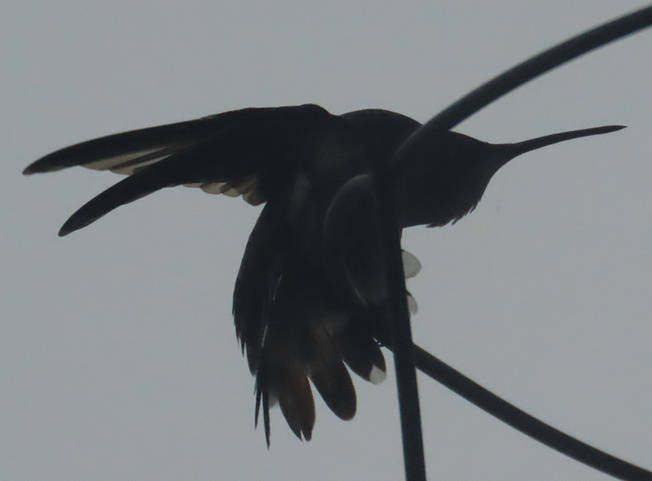
I liked the outline of this backlit hummingbird doing a big stretch, prior to flying off.
( Read more... )
yourlibrarian posting in common_nature gloomfiles posting in newcomerssoemandasakiyume mdlbear
Today I am thankful for...
authorized_keys
files. And TIL how to find out the PHP version a WP site is using.)
Some self-confidence would be helpful, but...
 loganberrybunny
 wychwoodmrissa
Carol Carnac, Crossed Skis. Kindle. Look, even for me this had a very large and not very differentiated cast. I like Carnac, who is also E.C.R. Lorac, and the skiing party mystery had its charms, but what I really want most out of mysteries is characterization, and this was more puzzle than characterization.
Agatha Christie, The Murder at the Vicarage. Kindle. This, on the other hand, was lots of vividly sketched (though not deep) characters in Miss Marple's village running around being people at each other. I think it's the last of hers that I haven't read yet that the library has in digital form. It was a good one to go out on.
Umberto Eco, The Name of the Rose. Reread. Well, this was where I'd left it, more or less. This is the sort of book that's absolutely why I only sort of behave as though stories should be written as short as they'll go, I don't actually believe it, because no one could possibly argue that the descriptions, the lists, or even the philosophical arguments couldn't be trimmed a little, and yet it is the book it is because they weren't. I do think that writing it in a substantially male-only setting set it up to age better than a lot of work of its era.
John M. Ford, Heat of Fusion and Other Stories. Reread. Every reread there are small details I've forgotten and large feelings I'll have, though not always the same large feelings. This time "Erase/Record/Play" was the one that made me go off thinking a lot. Next time something different.
James Alistair Henry, Pagans. I loved this. It's an alternate history mystery of the "cross-cultural pair of cops" format, like if Bon Cap Bad Cop was set in an England where the Norman Conquest never happened and Christianity's toehold in Europe was fairly minimal. I hope he writes more like this, or more like something.
Gwyneth Jones, Big Cat and Other Stories. My favorite story here was from the Bold As Love universe, which remains far and away my favorite thing Jones has ever done.
Ursula K. Le Guin, A Wizard of Earthsea (reread) and No Time To Spare: Thinking About What Matters. Kindle. The second volume was actually a great deal less of thinking about what matters than some of Le Guin's other essay collections. This was mostly collected blog posts. Fine for that but not more. I hadn't reread A Wizard of Earthsea in ages, but it continues to be like a Shaker chair, simple lines that do what they do admirably.
Ken Liu, The Passing of the Dragon and Other Stories. I tend to like Ken's long-form work better than his short-form work (do I want to reread his big fantasy series: yes absolutely), but the middle of this volume was so lovely, definitely worth having around.
Jenn Lyons, The Sky on Fire. If you'd like a ripping dragon adventure yarn, this is exactly that, with modern sensibilities so you don't have to worry about the sexism (racism, homophobia, etc.) fairy showing up and making the fun evaporate. Several people I love are getting this for Christmas.
Val McDermid, 1979. Kindle. What an interesting structure for a mystery series. The detective is an investigative journalist, and the books are set ten years apart, with McDermid's experiences as a young Scottish lesbian journalist informing the shape and texture of the entire thing.
Walter M. Miller, A Canticle for Leibowitz. Reread. Another one where setting it in a largely single-sex setting has probably improved how the book has aged. It's not perfect, but it's very readable prose and a good snapshot of an era. (Not the era of its setting, the anxieties of the era of its writing. But that's a very useful thing for a book to do.) Post-apocalyptic monasticism develops around what limited resources people have.
Hope Mirrlees, Collected Poems. As much as I love Lud-in-the-Mist, these poems were very not for me--they were going in a direction of a kind of formality/formalism that I don't much care for and away from the poetry of the time I liked a lot. Well, now we know.
P.L. Travers, Mary Poppins in Cherry Tree Lane. Reread. This is like the children's book equivalent of a novella: it's probably a novelette in length, but unlike the Poppins books I remembered better, it was just one story, a Midsummer story, that was a jumble of previous characters and very much had the feel of Mary Poppins Helps Pamela Travers Pay Her Bills.
Anthony Trollope, The Small House at Allington. Kindle. This was one of the least offensive Trollope novels I've ever read, but of the ones that didn't offend me enough to just stop reading them, it's also not one of the more interesting. All sorts of things are summarized with the comment that he doesn't have enough time to go into them here, but considering what he makes the time to go into, both here and elsewhere, this is not satisfying for me.
Patricia C. Wrede, Calling on Dragons. Reread, Kindle. This is very much a bridge book between the first two and the last one, not something I'd recommend reading as a stand-alone. Start at the beginning before you move on to the blue flying donkeys.
Jane Yolen, Sister Light, Sister Dark and White Jenna. Rereads, Kindle. I read these when they were new and I was small, and then not since, so my memories of them were very vague. I definitely did not remember the innuendo about the shadow sisters! I think it's interesting that she handled the shadow sisters so precisely that there were a million possible questions about them but also utter clarity that that was not the story she was telling.
blood_pomegranate posting in newcomersfox[watch this space] (A letter will be here by the time I finish my submission; I'm making this post now just so I know what the link will be. Carry on!)
Hello, new friend! I'm so happy you're here! . . . I also note that since last year's Yuletide letter I have posted seven (7) times, exactly none of which were on happy topics, including any type of Yuletide wrapup in which—and I can't believe this!, because I remember saying how delightful it was!, but apparently I only did so in a comment on the story itself!—I praised my delightful gift (A Slow Morning, by ConfusedCyndaquil, Will Darling Adventures, Will/Kim) and acknowledged my own submission (Disaster Preparedness, for
DWEmma, Sports Night, Casey+Dana). I seem to spend most of my online / social media time on Tumblr (
agentreynard) and Discord (
![[discord.com profile]](https://www.dreamwidth.org/img/silk/identity/user_other.png) agentreynard) these days and just come here to record hard times when I'm struggling, but those platforms don't lend themselves well to Yuletide letters, do they? So here this is, and please believe me when I tell you that a lot more goes on in my life than just nightmares and my aging mother losing her mind. Honest!
agentreynard) these days and just come here to record hard times when I'm struggling, but those platforms don't lend themselves well to Yuletide letters, do they? So here this is, and please believe me when I tell you that a lot more goes on in my life than just nightmares and my aging mother losing her mind. Honest!
I love Yuletide! Except for two years when I couldn't do it for family-emergency reasons and then later the first five years after my son was born [about two weeks before the posting deadline; it wouldn't have been wise for me to sign up that year at all!], I've been here since the second Yuletide. You will have an easy time pleasing me and a hard time disappointing me. Fear not. Let's have a great time together. The fellow fan and Yuletider who knows me best is ellen_fremedon (fremedon), who has agreed that you can ping her if you need insider info.
My general DNWs as I listed them in my signup (did I? I should have. I usually do.) are these:
If I have further thoughts, I will return and post them here, but like I said, you can also approach Ellen if the signup/this letter leaves you stumped and you need insight.
As we have also been asked in the past to affirm that treats are also welcome, let me assure you: Treats are also welcome! In fact, all the opt-ins you could ever opt in to are also great. Go wild. ❤️
Have a great time and happy Yuletide!
rebeccmeisterpetrea_mitchellbooknook October review-a-thon."Here, feel how tight this muscle is in your neck." And [the speech therapist] placed my hand on a neck muscle.
"You're right," I said. I really didn't notice any difference in the muscles, but I didn't want to hurt her feelings. That was dumb, but it is a common reaction of patients: don't upset the doctor or he or she won't like you and won't take good care of you. I was startled by that insight. Had I known that before? Would it have changed my relationship with my patients? I wasn't sure.
oursinThis was one of those weeks when several things come along making demands upon one's time and energies and while some of this might be considered to be what one has let oneself in for -
- really could have done without all of it having expectations of me Doing Something with a fair degree of expedition, even if some of this was pressure I was putting on myself.
It was really just as well that I found that the rescheduled postponed seminar - which I learnt about very late in the day - was already booked up so I couldn't get to it.
Not the week to have been smitten with a little story idea that I'd like to work on.
rebeccmeister![[syndicated profile]](https://www.dreamwidth.org/img/silk/identity/feed.png) atlas_obscura_places_feed
atlas_obscura_places_feed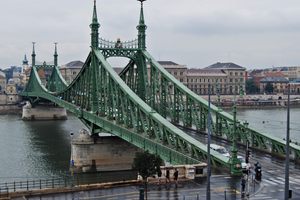
Walking through Budapest, it is impossible to ignore the stunning bridges. One in particular garners the attention of tourists, the Szabadság híd, or Liberty Bridge. It is ornate, green, and connects two very important parts of the city — Gellert Hill and the Central Market. It is also the only central bridge with old-timey trams regularly running across it, making it an iconic photo spot. But if you are lucky enough to find the Danube River level low enough, you can peer over the edge and see the ruins of its former self beneath the river.
The Ferenc József Bridge was destroyed during the bombings of the Battle of Budapest in January 1945. On most days, that is a history that is easily forgotten by pedestrians crossing the bridge and enamoured with the fantastic views of the city that it offers. But when the weather and the temperature along the Danube collude to make the levels low as they so often are in summer, the lost remnants of the old bridge appear close to the surface and sometimes even jut out of the water.
What you're looking at is the skeleton of the bridge that was destroyed by a Soviet shell detonating German explosives left on the bridge on 16th January 1945 in what is now known as the Siege of Budapest.
Unfortunately, this is likely to become a common sight if Hungary (and the rest of Europe) continue to swelter through hot, dry summers brought on by climate change.
runpunkrunyourlibrarian in common_nature - Hummingbirds, Sunsets and a Green Herongloomfiles in newcomers - writing ettiquite for dwsoemand - WBCQasakiyume - Spooktober 22: They were 11mdlbear - Thankful Thursdayloganberrybunny - Time to batten down those hatchesfiachrastudios in ![[site community profile]](https://www.dreamwidth.org/img/comm_staff.png) dw_community_promo - Introducing the Daggerheart communitywychwood - trying to reconstruct the theoretical use cases the devs had is my least-favourite archaeologymrissa - Won't someone think of the childrenmrissa - Books read, early Octoberblood_pomegranate in newcomers - New to Dreamwidth ! Confused on how and where to post to a fandom ?bookscorpion in common_nature - Swiss Chardfox - dear Yuletide writerrebeccmeister - Does your city have one of these?petrea_mitchell - Review: A Taste of My Own Medicineoursin - Everything happening at oncerebeccmeister - Oh allergies [status, rowing]atlas_obscura_places_feed - Ruins of the Ferenc József Bridge in Budapest, Hungaryjuan_gandhi - фоточки из Ангулемаrunpunkrun - Watching the Screentimeasmymeasure
dw_community_promo - Introducing the Daggerheart communitywychwood - trying to reconstruct the theoretical use cases the devs had is my least-favourite archaeologymrissa - Won't someone think of the childrenmrissa - Books read, early Octoberblood_pomegranate in newcomers - New to Dreamwidth ! Confused on how and where to post to a fandom ?bookscorpion in common_nature - Swiss Chardfox - dear Yuletide writerrebeccmeister - Does your city have one of these?petrea_mitchell - Review: A Taste of My Own Medicineoursin - Everything happening at oncerebeccmeister - Oh allergies [status, rowing]atlas_obscura_places_feed - Ruins of the Ferenc József Bridge in Budapest, Hungaryjuan_gandhi - фоточки из Ангулемаrunpunkrun - Watching the Screentimeasmymeasure


